textovercalls
Quick call? Free for a huddle? Hi, You there? Can we jump on a call? Got a sec? Let's sync up Can you hop on?
Async Communication  ·  A field guide

Stop interrupting.
Start writing messages
that actually work.

Every unexpected call breaks focus. It takes the average person 23 minutes to fully recover after an interruption and most calls could have been a message.

Say what you need, why it matters, and how urgent it is — all in one message.

Writing a clear message is a sign of respect. Firing off a call request is a sign of laziness.

Below: three examples from the cast of Breaking Bad. And yes there is a also a time to pick up the phone.
Featuring Heisenberg, Pinkman, Saul & Gustavo · No meth involved

● Poor

No context, all friction

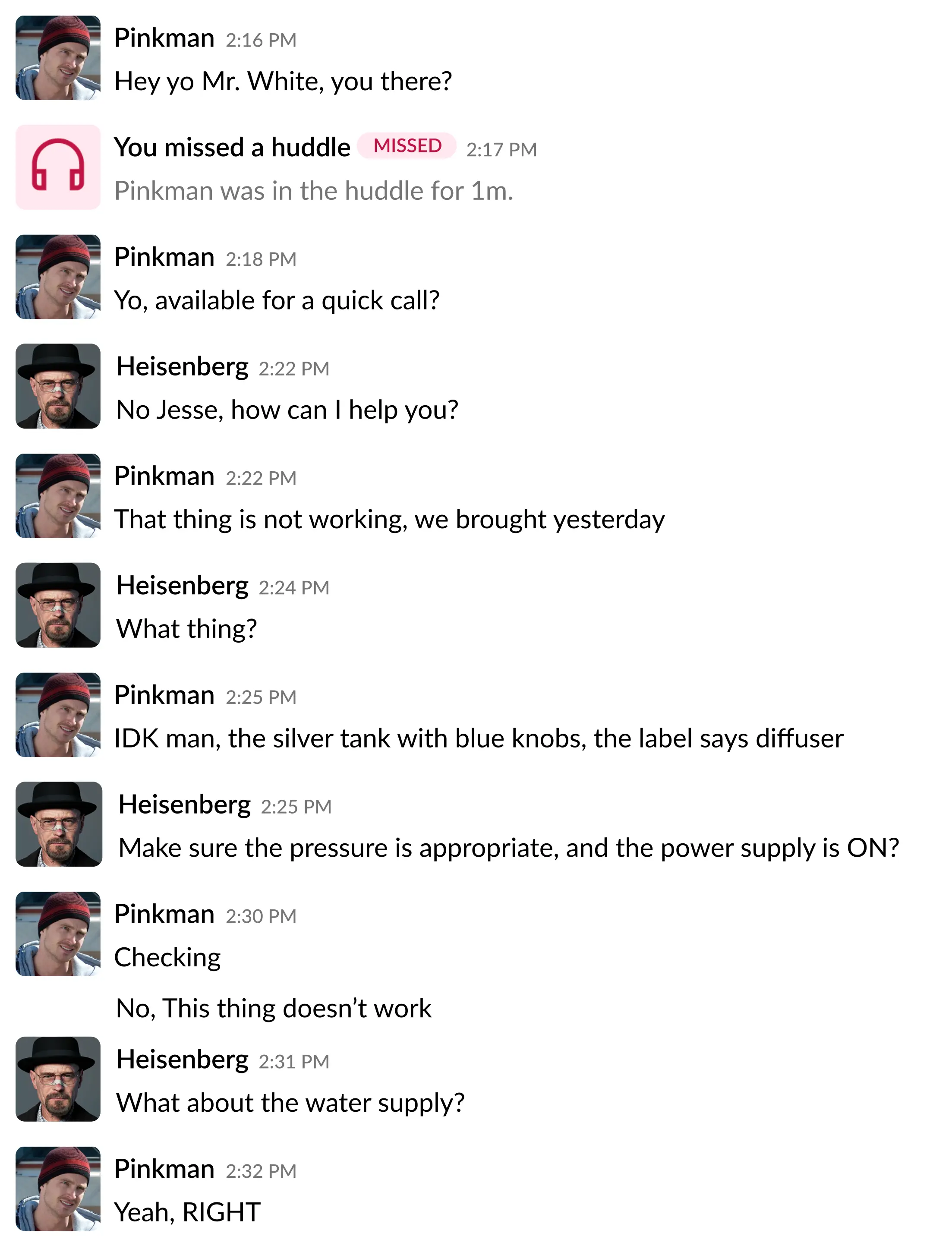
Pinkman pings Heisenberg without any setup — an attempted huddle call out of nowhere, then vague fragments about "that thing." Every message forces a follow-up question. Nothing gets resolved.

  • Calls directly without context — forces an interruption before the conversation even begins.
  • Vague and fragmented — each message requires a follow-up just to understand the last one.
  • Midway through, Heisenberg still has no idea what the actual problem is.
  • Tone is reactive and frustrated — making resolution harder, not easier.
Poor async messaging — Pinkman pings without context
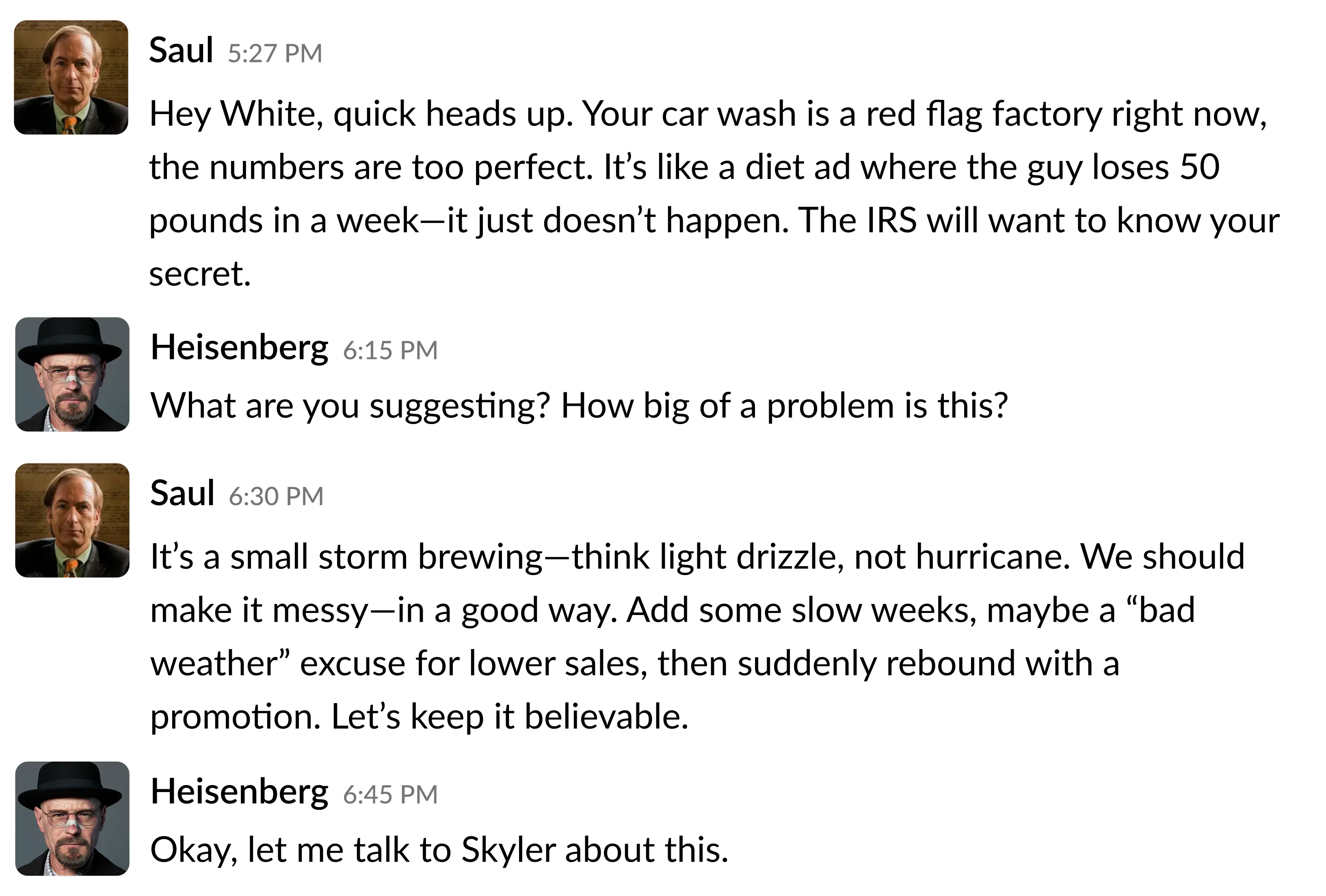
Good async messaging — Saul with a clear metaphor
● Good

Clear problem, vague handoff

Saul opens with a vivid metaphor that makes the risk instantly understandable. He's concise and proposes a direction — but leans on mild urgency that isn't quite earned.

  • Opens with a clear metaphor — makes the problem immediately understandable.
  • Concise, highlights the risk, and suggests a creative solution in one message.
  • Tone is calm and pragmatic, easy to respond to thoughtfully.
● Great

One message, zero questions

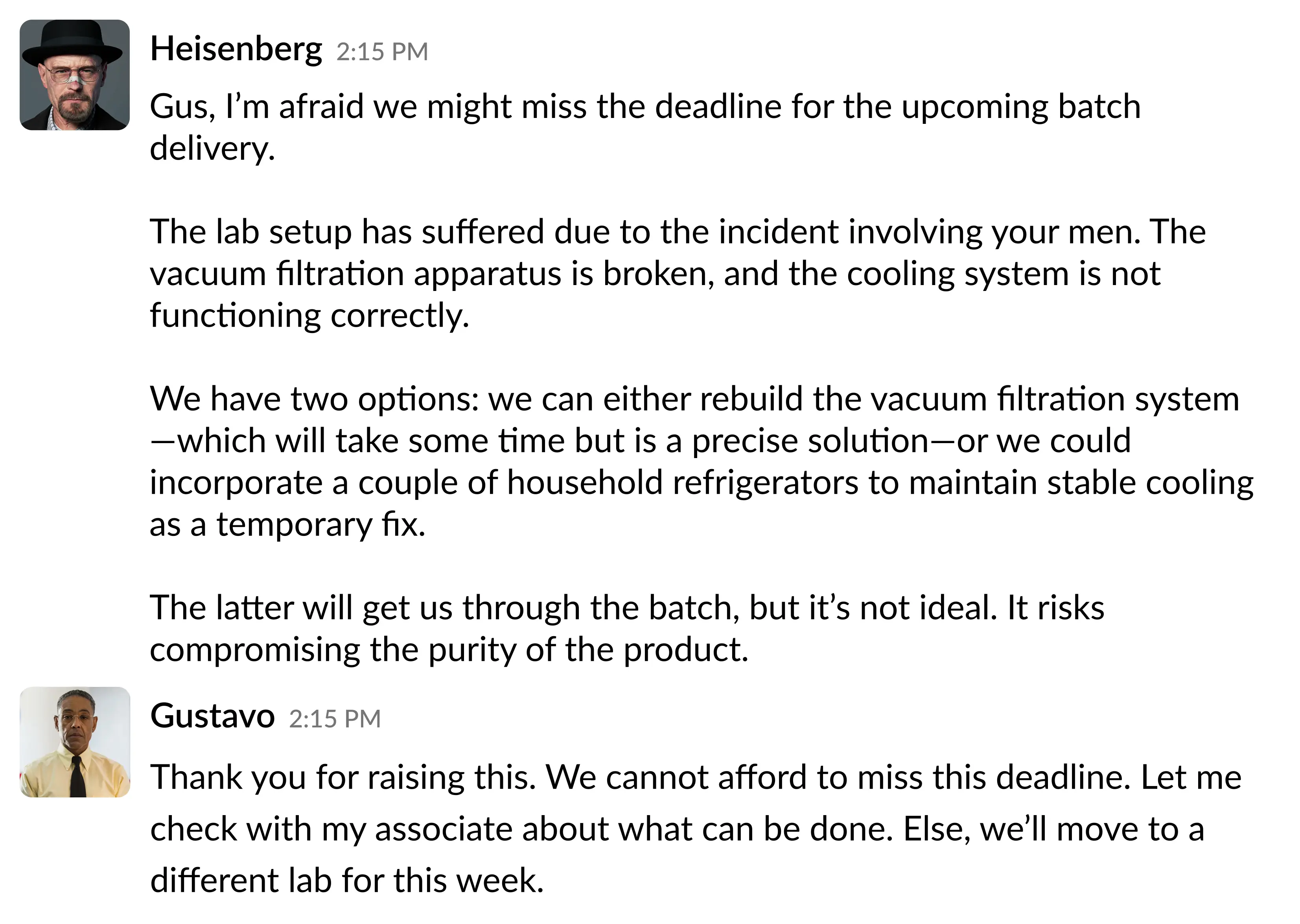
Heisenberg opens by clearly naming the issue and its stakes. He shares all relevant context — causes, risks, two concrete options, and lets Gustavo respond on his own schedule.

  • Clearly states the issue and urgency upfront — Gustavo knows what's at stake immediately.
  • Shares causes, risks, and two concrete options, responder can actually help without asking anything.
  • Composed and professional. The thread becomes a written record for both parties.
Great async messaging — Heisenberg briefs Gustavo fully
Before you hit send

A quick check

Five things worth confirming before sending. If you tick all five, your message is ready. If you can't, rewrite, don't call.

My first sentence says what I need and why it matters.
They can reply without asking me anything back.
If I wrote "urgent" — it actually is.
I've made a recommendation or proposed next steps.
I've re-read this message once as if I were the recipient.
✓ Good to send.
The exception

Sometimes you should just call.

Async isn't a religion, it's a default. There are situations where a voice call is genuinely the fastest, kindest, or clearest path.

Reaching for the phone in the right situation isn't a failure of async discipline. It's wisdom.

  • 01Strong emotions or sensitive news that could be misread in text.
  • 02More than 3 back-and-forths without resolution, a 5-minute call will resolve it.
  • 03A genuine emergency where minutes matter, not hours.
  • 04Real-time brainstorming where ideas build rapidly on each other.
  • 05The other person has said they prefer calls for this kind of thing — respect that.
  • 06Onboarding someone where a live walkthrough saves hours.
Link copied to clipboard